We also learned about the properties of water which consists of water being polar, it's ability to form hydrogen bonds, it's less dense when it's frozen, it's ability to absorb a great deal of energy, it's very attractive, with it having cohesion, attraction between molecules of the same substance, adhesion, attraction between molecules of different substances, and capillary action, both cohesion and adhesion, and it's great for making solutions since it's often used as a solvent, the substance that dissolves the solute, the substance that is being dissolved.
We also learned about pH, acids, and bases. pH is the measurement of positive hydrogen ions (H+) in a solution. Acids are anything that have more H+ ions than OH- ions, and are below 7 on the pH scale. Bases are anything that have more OH- ions than H+ ions and are above 7 on the pH scale. 7 is neutral pH, which is water.
Then we learned about four big macro molecules, carbohydrates, lipids, proteins, and nucleic acids. Carbohydrates are sugars that are shaped like rings, which are made of carbon, hydrogen, and oxygen, and can be chained together to form more complex sugars. Their main function is to provide energy for consumers and store energy for producers. Lipids are large molecules that include fats, phospholipids, oils, waxes, and cholesterol and are structured with long chains of hydrogen and carbon. Their main functions are to store energy, break bonds to give energy to the body when glucose is running low, make up cell membranes, and make hormones. Proteins are large molecules made of smaller molecules called amino acids, that are chained together. They are used for supporting the body, helping cells communicate, speed up chemical reactions, and let things through the cell membrane. Lastly, nucleic acids are large molecules composed of up to thousands of nucleotides, which are made of a sugar, a phosphate, and a nitrogen containing base. They are used to make DNA, which serves as a blueprint for proteins, RNA, and ATP, which is a primary energy transferring molecule in a cell.
Carbohydrate

https://commons.wikimedia.org/wiki/File:Saccharose.svg
Protein

https://en.wikipedia.org/wiki/Molecular_geometry
Fat
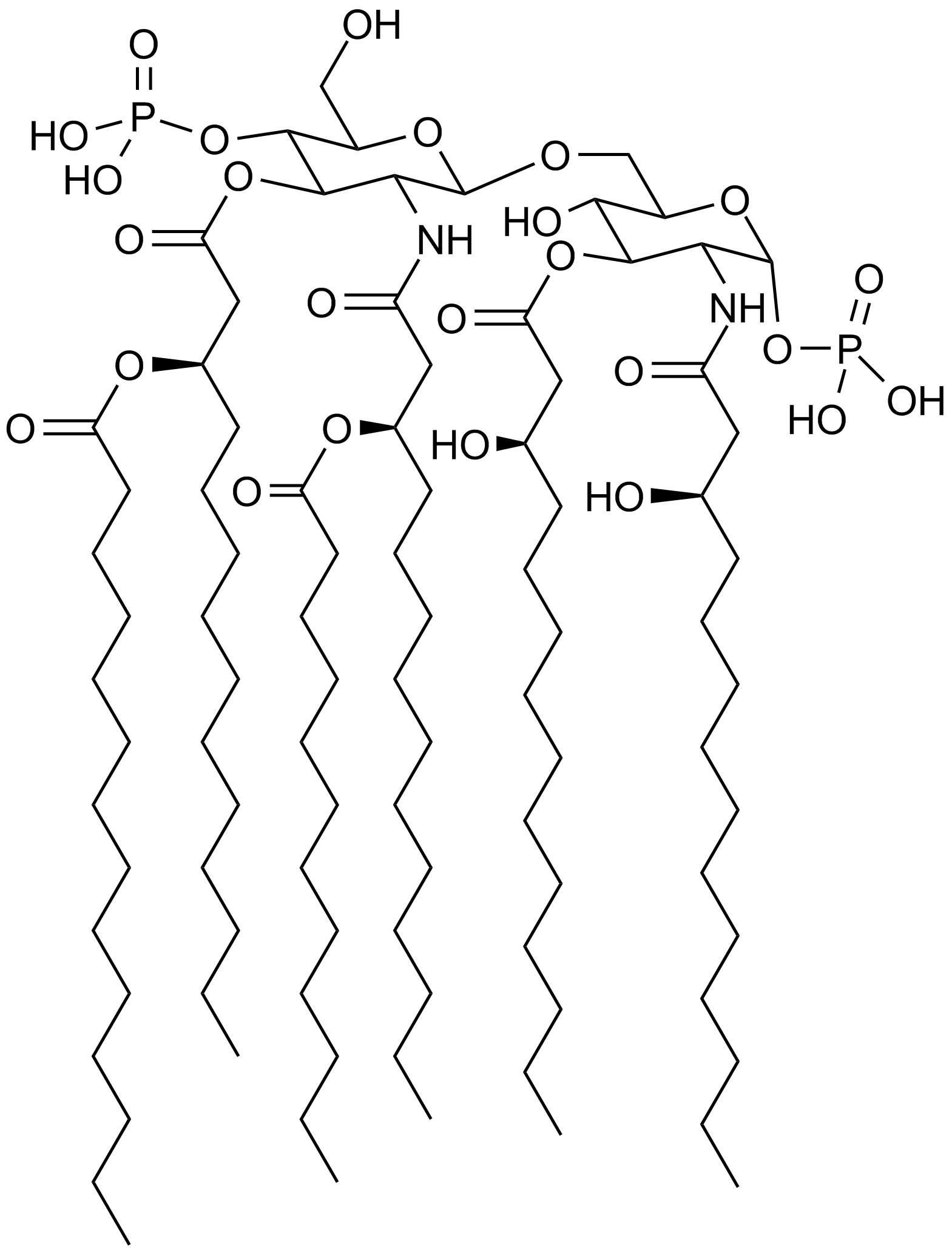
https://en.wikipedia.org/wiki/Eritoran
Nucleic Acid

https://en.wikipedia.org/wiki/Ribonucleotide
Lastly we learned about enzymes, a protein used to speed up chemical reactions in the body by lowering the activation energy, which is the amount of energy needed to create a reaction. It has four structures, primary, secondary, tertiary, and Quaternary structure, primary being the most basic, and Quaternary being the most complex. Some factors that effect enzymes are pH and temperature. If these are too high or too low for a certain enzyme, it causes the enzyme to start denaturing, which makes it unravel and can slow down or stop its function. Simple denature only affects the tertiary and Quaternary structures, and is reversible. Complete denature affects the secondary and primary structures, and is irreversible.And this is what we learned this unit.
Somethings I learned from the labs were how pH and amount of substance effected products produced by enzymes, how certain variables can cause enzymes to create products, like cheese, faster, and how simpler carbohydrates taste sweeter than complex ones.
I understood most of the concepts we learned this unit, and the labs helped me better understand them. Some setbacks I had were being too quiet for my group to hear me, but I got louder as the days went by.
I want to learn more about how ATP works in more detail. An unanswered question I have is why carbohydrates shaped like rings and what benefits it has. I wonder about what other substances have similar properties to water.

No comments:
Post a Comment