 |
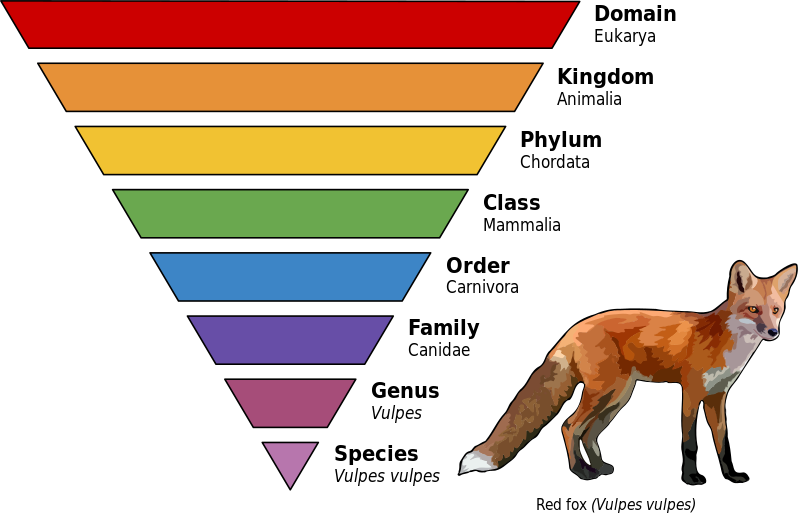
| https://commons.wikimedia.org/wiki/File:Taxonomic_Rank_Graph.svg |
We then studied bacteria in more detail. Bacterial cell walls contain peptidoglycan. There are two cell wall structures, gram-positive, which is one wall made of peptidoglycan, and gram-negative, which has less peptidoglycan and has a outer membrane that can be toxic. Bacteria use either use a flagella or flagellum to move. Chemoheterotrophs are heterophic bacteria that take in organic molecules. Photoautotrophs use light to convert carbon dioxide and water into carbon compounds. Chemoautrotrophs use energy to directly from chemical reactions. Obligate anaerobes cannot have oxygen. The importance of bacteria is that they are decomposers, nitrogen fixers, and can be used for biotechnology.
Then we went over viruses. Viruses aren't considered cells or living. They are very small infectious particale consisting of nucleic acids enclosed in a protein coat, and, in some cases, a membrane envelope. Viral genomes may consist of a double or single stranded DNA and/or RNA. Depending on its nucleic acids, viruses are either classified as a DNA or RNA viruses. Capsids are protein shells that enclose the viral genome, and some viruses have membarnons envelopes that help them infect hosts, which are called viral envelopes. Once a viral genome has entered a cell, the cell begins to manufacture viral proteins. A lytic infection is when a virus enters a cell, makes copies of itself, and causes the cell to burst. A lysogenic infection is when a virus integrates its DNA into the DNA of the host cell, and the viral genetic information replicates along with the host cell's DNA.
We studied the kingdom of fungi next. Fungi cell walls are made of chitin, fungi absorbs food through hyphae, they have a fruiting body, and spores. They are multicelluar organisms, besides yeast. There is the sac fungi, morels, truffles, bread models, and club fungi. They have a very complicated reproduction process. Fungi can acts as mutalsists. They are useful because they can be food, antibiotics, and model systems for molecular biology. They can act as pathogens also. They are the main decomposer in any ecosystem.
Then, we looked at the kingdom of plants. The major adaptions plants have are cuticle, a waxy protective layer, a vascular system, which allows resources to move to different parts of the plants, pollen, seed/s, and fruit. There are seven classes of plants: bryophyta (mosses), pterophyta (ferns), gymnosperms (cone bearing plants), cycads, which look like palms, ginkos, conifers, and angiosperms (flowering plants). There are two major types of angiosperms, monocots, single seed leaf, and dicots, two seed leaves.
We then studied invertebrates in two separate parts. In the first part, we learned that over 97% of all animal species are invertebrates. The way invertebrates are categorized is by body plan symmetry, tissue layer, and development patterns. The phylum of invertebrates are proifera, or sponges, cnidaria, playhelminthes, mollusks, and annelida. Proifera has specialzed cells, but no tissue. Cnidaria are the oldest exisiting animal phylum with special zed tissue. It has four classes, scyphozoans, which has jellyfish, anthozoans, which has corals and sea anemones, hydrozoans, which has hydras, and cubozoans, which has box jellies. Playhelminthes are simple bilateral animals. It has three classes, plananias, flukes, and tapeworms. Molluskas are very diverse. They have a complete digestive system with two openings. It has three classes, which are gastropods, which has snails and slugs, bivalves, which has clams, oysters, and mussels, and cephalopods, which has octopus, squid, cuttlefish, and nautilus. Lastly, annelidas have segemented bodies. There are three groups, earthworms, marine worms, and leeches.
We then studied the second section of invertebrates, arthropods, which are the most diverse animals on Earth. They all have exoskeletons made of chitin, jointed appendages, and segmented body parts. They are classified into five groups, trilobites, crustaceans, echinoderms, cheilcerates, insects, and myrpaids. Trilobites are extinct and bottom feeders. Crustaceans share several common features: two distinct body sections, one pair of appendages per segment, and carpace. Echinoderms are vertebrates with radical symmetry. They have an internal skeleton made of interlocking ossicles, a water vascular system, a complete digestive system, some regenerate limbs, and most reproduce sexually. The five classes are feather stars and sea lilies, sea stars, brittle stars and basket stars, sea urchins, sea biscuits, and basket stars, and sea cucumbers.
Lastly, we studied chordates, which we also studied in two parts. In the first part we learned that the phylum chordata, which contains both vertebrates and invertebrates. There are seven classes, agnatha, which are jawless fish, condircthyes, which are cartilaginous fish with jaws, osteicthyes, which are bony fish with jaws, amphibia, which have four limbs and live on both water and land, reptilia, which have eggs surrounded by a membrane, and mammalia, which are mammals, have the presence of hair, and aminote. In this first part, we looked more closely at agntha, condricthyes, osteicthyes, and amphibia. The agntha have two groups existing today, lampreys and hagfish. The condricthyes have cartilage for bones, which osteicythes have bones for bones. Lastly, amphibia have large shoulder and hip bones, a mobile, muscular tongue, and either breathe through their skin, lungs, or gills. They are seprated into three groups, salamanders, which have a long body, four walking limbs, and a tail, frogs and toads, and caecilians, which are legless, burrow, and are tropical amphibians.
Finally, we concluded this unit with the final part of chordates. The class of reptilia are ecotherms, meaning they are cold-blooded, covered with dry scales, reproduce by laying or retaining amniotic eggs, have a three-chambered heart, and cloaca. They have 4 groups, turtles, tortoises, and terrapins, which have a body encased shell, snakes and lizards, which shed skin and have a flexible skull, and crocodilians, which are semi-aquatic predators. The class of aves, or birds, have hollow bones, feathers, and v-shaped wishbone, and "hands" that are missing their fourth and fifth finger. Finally, the class of mammalia are active, large-brained, endotherms with complex social, feeding, and reproductive behaviors. They have hair to retain heat, mammary glands to produce milk, the middle ears have three bones to hear higher-pitched sounds, and they have chewing jaws to break up food quicker. They are divided into three groups, monotremes, which lay eggs, marsupials, which give birth to live young that grow to maturity inside a pouch, and eutherians give birth to live young that have completed fetal development.
 |
| https://commons.wikimedia.org/wiki/File:Tree_of_life_with_genome_size.svg |
Something I want to learn more about is how scientists place new found species into a category if the animal has similar characteristics to two classes or genuses. An unanswered question I have is just how many species will we unearth in the next couple years. I wonder about what type of professions use this information for a greater understating of their topic.
This unit, we presented on a certain species. I presented on the archaopteryx. I spoke a bit too fast, due to nervousness, going a minute under my practice times. I knew my topic and practiced, but ultimately lost control of my pacing. Next time, I'll focus on my pacing and pratcice in front of others so that I will be more comfortable when I presented in front of a group.
This unit we also created a geological timeline, which I have linked to below.
Geological Timeline

No comments:
Post a Comment