In this unit we studied genetics and reproduction. We did a coin sex lab to find out how to use
probability to predict what traits an offspring will have. In this lab, we flipped coins, which represented different
alleles of certain
genes from gametes
produced by
meiosis, like hair color, an
autosomal trait, and gender, a
x-linked inheritance trait, to show how traits are predictable and unpredictable when an offspring is made. We did
monohybrid and
dihybrid cross simulations. Our dihybrid cross simulation shows how traits are predictable and unpredictable. We used the traits hair color, blonde (recessive) and brown (dominant), and eye color, blue (recessive) and brown (dominant). We predicted that two children will be
homozygous, while 14 of them will be
heterzygous. Our results where 8 brown hair and eyes (BBEE or BbEe), 4 brown hair and blue eyes (BBee or Bbee), 3 blond hair and brown eyes (bbEE or bbEe), and 1 blond hair and blue eyes (bbee). We had 4 BBEE and 1 bbee. That was 2 more homozoygous pairs than we were excepting. This is because we could not predict if a coin would land on a head or tail. Because of these results, I claim that even though we know what traits offspring can possibly
inherit, we don't know the exact ones they will inherit, also known as probability. This is shown in the results we got from our dihybrid cross examination. The limit of using probability to predict an offspring's traits is we don't know what two gametes will combine and what type of alleles they have in either of them. This understanding relates to my life since no one in my family has blond hair but me, so I assume both my parents had a recessive allele and I got both of them, therefore I got blond hair.
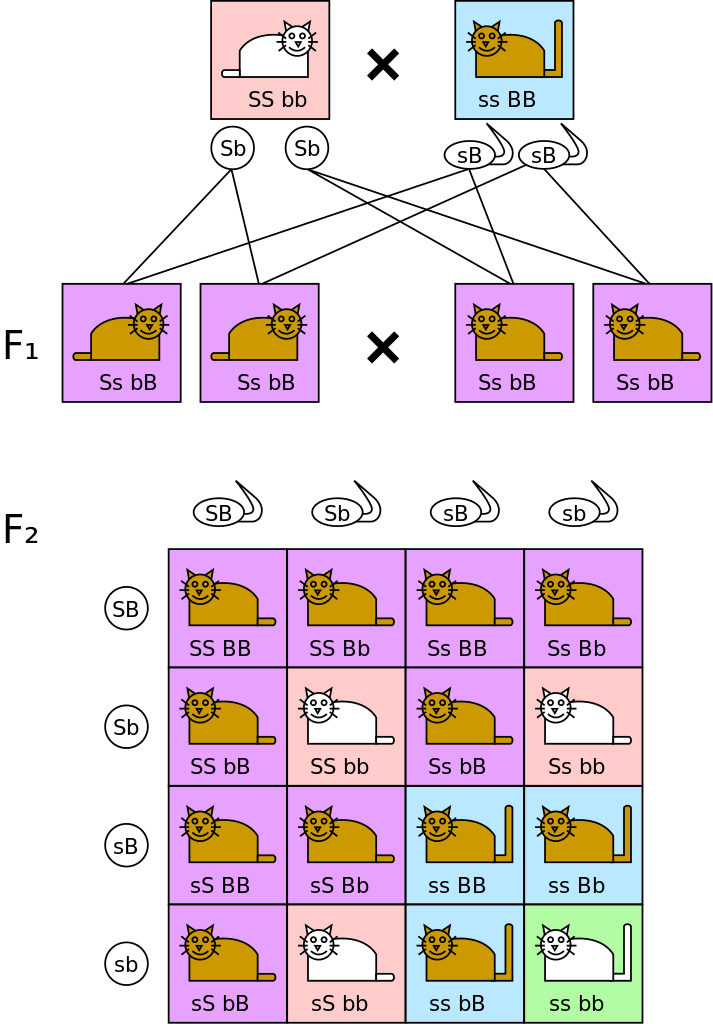 |
| Tocharianne. Dihybrid Cross. Digital image. Wikimedia Commons. N.p., 21 Dec. 2006. Web. 25 Nov. 2016. <https://commons.wikimedia.org/wiki/File:Dihybrid_cross.png>. |
Besides studying how traits are passed from parents to their offspring/s, we studied mitosis, how a cell splits and creates a copy of itself, meiosis, the creation of gametes/sex cells, asexual reproduction, reproduction without sex, sexual reproduction, reproduction with sex, how Mendel discovered why sex is so great by studying pea plants and their traits, his sex laws, the law of segregation which states that gene pairs for a trait separate when gametes are formed, and the law of indepdent assortement which states that gene pairs separate independently from each other during meiosis. austomal and x-linked inheritance, and gene exceptions and complications. One theme was exploring the concept of why is sex so great. We learned that sex causes genes to mix and create new combinations, which helps new traits that will help an offspring to survive to be formed, while asexual reproduction, reproduction without the mixing of genes, creates clones and since mutations are the only way to differentiate organisms, these organisms do not create new traits often and have a less likely chance of surviving as a species. Some essential understandings were the importance of the cell cycle, what sex is, the significance of chromosomes, the relationship between sex, genes, and traits, the parts of sex are random and the parts that are predictable, the different ways sex leaves you stuck, and how genetics gets complicated.
 |
| Meiosis Stages. Digital image. Wikimedia Commons.
N.p., 21 June 2016. Web. 25 Nov. 2016.
<https://commons.wikimedia.org/wiki/File:Meiosis_Stages.svg>.
|
A setback I had during this unit was managing my time for the info graphic. I spent too much time researching about the information needed for the graphic at school, causing me to have to make the actual info graphic at home. A success I had was doing all the vodcasts early so I had more information for my info graphic and more time to complete it. A strength I had was being able to understand most genetic related concepts easily, while a weakness I had was learning the differences between Mendel's sex laws. A skill I learned from this experience is time management. I wish to learn more about genetically inherited diseases and what chromosome is responsible for what traits. An unanswered question I have is how and why mutations occur. I wonder about why we reproduce like this and if there are any other ways besides what we have discovered so far exist.

No comments:
Post a Comment