Saturday, June 3, 2017

Letter to a Biology Student

Hello there! My name is Liza Ovsiannikov. I’m currently 15 as you are reading this. I went to Foothill Elementary, Redwood Middle School, and am currently enrolled at Saratoga High. Last year I took MAP 9, french 1, drama 1, health/world geo, geometry, and biology. I don’t take PE since I have enough hours of extra curricular activities to do ISPE. School is definitely my highest priority currently, although I dance and play piano. When I first entered this room, I expected to receive lectures and take notes on cells, photosynthesis, and the human body in class. Well, in this class it’s a bit different.

You have something called the flip classroom. Basically, you take notes and receive lectures in the form of vodcasts at home, while in class you jump right into different labs and projects to do with the unit you are studying. Mr. Orre expects you to take notes on each vodcast, which is your homework along with textbook notes. Vodcasts and textbook notes take about 30 to 45 minutes. You keep this in your notebook, which will also contain a table of contents and several other pages Mr. Orre will require you to print out. When you first come into the classroom, he expects you to do the Do Now, which is usually a question you can answer if you did last night’s vodcast. For labs, you are expected to read procedures, complete the procedures, listen to instructions, write a write up, usually, and clean up correctly. Tests are multiple choice and have a collection of science jokes scattered around. You also have your own personal blog on blogger for science. You usually keep your lab write ups there, and other assignments. My personal favorite post on my blog is the pig dissection since it has an embedded video and is the most concise. My blog evolved throughout the year as more images were added, along with a slideshow and video, making each blog post more complex. I changed myself also. I gained better collaboration and time management skills.

Some of Mr. Orre’s pet peeves are talking over him, not cleaning up properly after a lab, and being an observer over a participant in labs. To earn a good grade, watch and take notes on the vodcasts and remember to study the big picture along with the small details. To earn good test grades, do not just read over the notes. Understand the big picture, and how everything during that unit connected to that. Now, so you don’t follow in my footsteps, do not make these mistakes, which I made. Number one, do not wait till the last day to take textbook notes and study. Number two, do not listen to music as you listen and take notes on a vodcast. Lastly, do not forget to submit your url to your blog post you have completed several days ago.


Overall, this class gives you a really solid understanding of biology. I found the vodcasts to take more time than they should, but the labs are really fun. Next year I’m taking chemistry honors since I have a general interest in science. To summarize, do the vodcasts, study smart, time manage, and do not talk over Mr. Orre.

 
- Liza Ovsiannikov

Wednesday, May 31, 2017

Pig Dissection

For this lab, we dissected a piglet. The purpose of this lab was so that we could have a visual representation of different systems throughout the human body, creating a clearer understanding of this unit. We used piglets since their  body system is similar to a human's. We studied different organs of the digestive, respiratory, circulatory, urinary, reproductive, and endocrine systems, which we learned about in class and in vodcasts. My favorite part of the dissection was cutting the pig open because I was able to see organs and gain a better understanding of the organs and their systems. The dissection was a valuable experience since we all gained a better understanding of the human body, since this was both a hands on and visual learning experience with audio learning added in when we created the video.


Monday, May 22, 2017

20 Time Reflection

For this 20 time project, I choose to study memory with a partner. Our ultimate goal was to find memorization techniques so that students would have an easier time studying. We also wanted to gain a better understanding on memory.

To achieve this goal, we created several experiments to study different variables of memory. Age, environment, and repetition were the three variables we decided to test. We tested age with a simple memory game. Environment was tested by having people read two articles and take mini quizzes for them in an organized and messy room. Lastly, repetition was tested by reading one article twice a day, while another one was read right before the test subject took the test.

This project did start a bit late, given that both my partner and myself didn't have a clear vision of what we should base our 20 time project on. So when we started, we were slightly behind everyone. Although, we were able to come up with experiments quickly, so we didn't ponder after we got our idea. We were able to get our data, but sadly were not able to explore the best study technique in the amount of time we had.

We learned that teens have a better memory than middle-aged adults, an organized room helps people retain information, and that repetition is a better way to study than trying to learn everything in one go.

My partner and I collaborated well. We did get off task sometimes, but we got back on track quickly. If I could do this project differently, I would try to get the experiments done faster, and maybe add on more of them to have a clearer understanding of memory and find better studying techniques. I also would time manage better. I've learned that I sometimes take charge in projects, and should let go of the reins a bit next time so that my partner would have more of a say.

I'm planning to finish this project so that I will know the best way to study next year. Also, I want to let others know this information so that they can find the best way to study too. I may continue this to find better ways for certain types of learners (visual, auditory, reading/writing, and auditory) to study, and personalize different studying techniques depending on what type/s of learning a person lean towards. 

Friday, May 12, 2017

Unit 9 Reflection

This unit was about taxonomy, which is the study of naming and classifying organisms. We studied the taxonomic levels, which are domain, kingdom, phylum, class, order, family, and genus. Organisms are named scientifically by their genus and species, which is called the binomial nomenclature system. There are three domains; they are archea, bacteria, and eukarya. The archea domain live in hydrothermal vents, hot springs, digestive tracts, anoxic muds, marshes, and petroleum deposits. The bacteria domain has actinomycetes, which produce antibiotics, symbiotic bacteria, which live guts and help with digestion, or in the roots of certain plants to help fix nitrogen, and cynabacteria, which are photosynthetic bacteria. Lastly, the eukarya includes fungi, animals, plants, and protists, which I will go into more detail later. The five kingdoms are monera (prokaryotes), protista, plantae, fungi, and animalia.
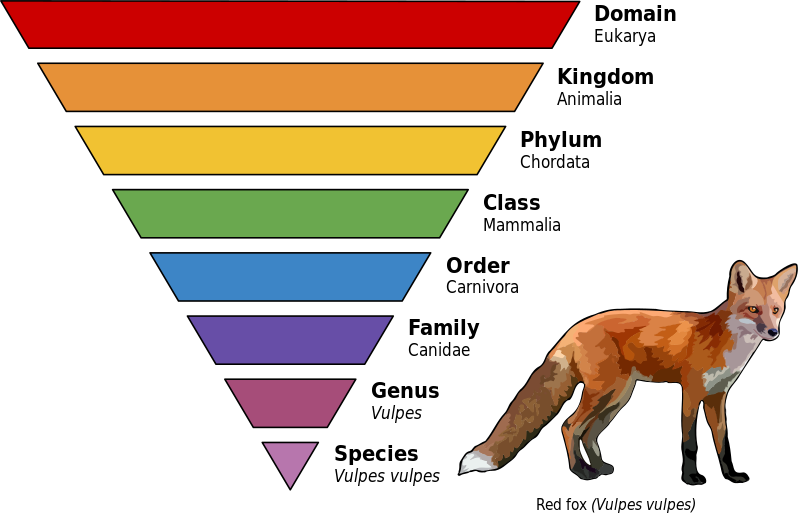
File:Taxonomic Rank Graph.svg
https://commons.wikimedia.org/wiki/File:Taxonomic_Rank_Graph.svg

We then studied bacteria in more detail. Bacterial cell walls contain peptidoglycan. There are two cell wall structures, gram-positive, which is one wall made of peptidoglycan, and gram-negative, which has less peptidoglycan and has a outer membrane that can be toxic. Bacteria use either use a flagella or flagellum to move. Chemoheterotrophs are heterophic bacteria that take in organic molecules. Photoautotrophs use light to convert carbon dioxide and water into carbon compounds. Chemoautrotrophs use energy to directly from chemical reactions. Obligate anaerobes cannot have oxygen. The importance of bacteria is that they are decomposers, nitrogen fixers, and can be used for biotechnology.

Then we went over viruses. Viruses aren't considered cells or living. They are very small infectious particale consisting of nucleic acids enclosed in a protein coat, and, in some cases, a membrane envelope. Viral genomes may consist of a double or single stranded DNA and/or RNA. Depending on its nucleic acids, viruses are either classified as a DNA or RNA viruses. Capsids are protein shells that enclose the viral genome, and some viruses have membarnons envelopes that help them infect hosts, which are called viral envelopes. Once a viral genome has entered a cell, the cell begins to manufacture viral proteins. A lytic infection is when a virus enters a cell, makes copies of itself, and causes the cell to burst. A lysogenic infection is when a virus integrates its DNA into the DNA of the host cell, and the viral genetic information replicates along with the host cell's DNA.

We studied the kingdom of fungi next. Fungi cell walls are made of chitin, fungi absorbs food through hyphae, they have a fruiting body, and spores. They are multicelluar organisms, besides yeast. There is the sac fungi, morels, truffles, bread models, and club fungi. They have a very complicated reproduction process. Fungi can acts as mutalsists. They are useful because they can be food, antibiotics, and model systems for molecular biology. They can act as pathogens also. They are the main decomposer in any ecosystem.

Then, we looked at the kingdom of plants. The major adaptions plants have are cuticle, a waxy protective layer, a vascular system, which allows resources to move to different parts of the plants, pollen, seed/s, and fruit. There are seven classes of plants: bryophyta (mosses), pterophyta (ferns), gymnosperms (cone bearing plants), cycads, which look like palms, ginkos, conifers, and angiosperms (flowering plants). There are two major types of angiosperms, monocots, single seed leaf, and dicots, two seed leaves.

We then studied invertebrates in two separate parts. In the first part, we learned that over 97% of all animal species are invertebrates. The way invertebrates are categorized is by body plan symmetry, tissue layer, and development patterns. The phylum of invertebrates are proifera, or sponges, cnidaria, playhelminthes, mollusks, and annelida. Proifera has specialzed cells, but no tissue. Cnidaria are the oldest exisiting animal phylum with special zed tissue. It has four classes, scyphozoans, which has jellyfish, anthozoans, which has corals and sea anemones, hydrozoans, which has hydras, and cubozoans, which has box jellies. Playhelminthes are simple bilateral animals. It has three classes, plananias, flukes, and tapeworms. Molluskas are very diverse. They have a complete digestive system with two openings. It has three classes, which are gastropods, which has snails and slugs, bivalves, which has clams, oysters, and mussels, and cephalopods, which has octopus, squid, cuttlefish, and nautilus. Lastly, annelidas have segemented bodies. There are three groups, earthworms, marine worms, and leeches.

We then studied the second section of invertebrates, arthropods, which are the most diverse animals on Earth. They all have exoskeletons made of chitin, jointed appendages, and segmented body parts. They are classified into five groups, trilobites, crustaceans, echinoderms, cheilcerates, insects, and myrpaids. Trilobites are extinct and bottom feeders. Crustaceans share several common features: two distinct body sections, one pair of appendages per segment, and carpace. Echinoderms are vertebrates with radical symmetry. They have an internal skeleton made of interlocking ossicles, a water vascular system, a complete digestive system, some regenerate limbs, and most reproduce sexually. The five classes are feather stars and sea lilies, sea stars, brittle stars and basket stars, sea urchins, sea biscuits, and basket stars, and sea cucumbers.

Lastly, we studied chordates, which we also studied in two parts. In the first part we learned that the phylum chordata, which contains both vertebrates and invertebrates. There are seven classes, agnatha, which are jawless fish, condircthyes, which are cartilaginous fish with jaws, osteicthyes, which are bony fish with jaws, amphibia, which have four limbs and live on both water and land, reptilia, which have eggs surrounded by a membrane, and mammalia, which are mammals, have the presence of hair, and aminote. In this first part, we looked more closely at agntha, condricthyes, osteicthyes, and amphibia. The agntha have two groups existing today, lampreys and hagfish. The condricthyes have cartilage for bones, which osteicythes have bones for bones. Lastly, amphibia have large shoulder and hip bones, a mobile, muscular tongue, and either breathe through their skin, lungs, or gills. They are seprated into three groups, salamanders, which have a long body, four walking limbs, and a tail, frogs and toads, and caecilians, which are legless, burrow, and are tropical amphibians.

Finally, we concluded this unit with the final part of chordates. The class of reptilia are ecotherms, meaning they are cold-blooded, covered with dry scales, reproduce by laying or retaining amniotic eggs, have a three-chambered heart, and cloaca. They have 4 groups, turtles, tortoises, and terrapins, which have a body encased shell, snakes and lizards, which shed skin and have a flexible skull, and crocodilians, which are semi-aquatic predators. The class of aves, or birds, have hollow bones, feathers, and v-shaped wishbone, and "hands" that are missing their fourth and fifth finger. Finally, the class of mammalia are active, large-brained, endotherms with complex social, feeding, and reproductive behaviors. They have hair to retain heat, mammary glands to produce milk, the middle ears have three bones to hear higher-pitched sounds, and they have chewing jaws to break up food quicker. They are divided into three groups, monotremes, which lay eggs, marsupials, which give birth to live young that grow to maturity inside a pouch, and eutherians give birth to live young that have completed fetal development.

File:Tree of life with genome size.svg
https://commons.wikimedia.org/wiki/File:Tree_of_life_with_genome_size.svg


Something I want to learn more about is how scientists place new found species into a category if the animal has similar characteristics to two classes or genuses. An unanswered question I have is just how many species will we unearth in the next couple years. I wonder about what type of professions use this information for a greater understating of their topic.

This unit, we presented on a certain species. I presented on the archaopteryx. I spoke a bit too fast, due to nervousness, going a minute under my practice times. I knew my topic and practiced, but ultimately lost control of my pacing. Next time, I'll focus on my pacing and pratcice in front of others so that I will be more comfortable when I presented in front of a group.


This unit we also created a geological timeline, which I have linked to below.
Geological Timeline

Thursday, April 20, 2017

Geological Timeline Reflection

In this project, we created a geological timeline of Earth's history. Three major events in Earth's history are the first evidence if life, bacteria, in the Archeozoic period, Pangaea breaking apart at the end of the Triassic period, and mammals starting to appear towards the end of the Triassic period. Bacteria appearing on Earth is a critical event since it was the beginning of life and set off a chain reaction that led us to today. Pangaea breaking apart is an important event on Earth since it created the continents we live in today. Lastly, mammals appearing and eventually dominating the Earth is a signification event on Earth since it carved the path for humans to evolve.

The scale of Earth's history surprised me. Not much happened in the very beginning and many major events happened towards the end of the timeline. More than half of the timeline were taken up by the Precambrian era. Humans evolved at the very tip of the timeline, only taking about a couple millimeters, when we had 9.2 meters total.

In our short amount of time on Earth, we have raised carbon dioxide levels, destroyed natural habitats, and much more.We live in the Cenozoic era, which has lasted about 131 million years. The other eras last from 212 to 4,200 million years. It took millions of years for bacteria to evolve into marine animals. And it took millions of years for those animals to travel onto land. We have changed Earth extremely quickly.

One question I have is what specific types of animals lived in each period.

https://commons.wikimedia.org/wiki/File:Pangea_political.jpg
https://commons.wikimedia.org/wiki/File:Eomaia_scansoria.JPG

Wednesday, April 12, 2017

Unit 8 Reflection

This unit was about evolution. We first studied gradual change. We learned about variation, which is any difference in traits within a population. It exists because of crossing over, meiosis, mutations, and sex. Variation in a species allows people to artificially select certain organisms with traits they want, like color or size. This is called artificial selection.

Then we studied Charles's Darwin's observations and conclusion. His observations where that all sexually reproducing species have high genetic variation, traits are inherited from parents to offspring, all species are capable of producing more off springs than the environment can support, and competition makes it so that only certain offsprings can survive and reproduce due to limited resources in the environment. His conclusions were that there are winners and losers in nature, and that population will start to look like the winners.

The next thing we studied was how evolution is measured. We first learned about the gene pool, which is the total of all alleles in a population, and allele frequency, which is how common an allele is in a population. The steps to determine allele frequency is to first add up the total of all alleles, then add up total for each type of allele, and finally, for each type of allele, divide the number by the total. We learned about how the gene pool slowly evolves. As frequencies change due to natural selection, the gene pool starts to have a higher number in winners. Although, lethal alleles that are recessive can hide in a population, which is why we still see them today.

Then we learned about speciation, which is the rise of 2 or more species from one exiting species. Speciation is caused by reproductive isolation, which is when a population is split into two and eventually the two populations cannot reproduce anymore. Three forms of this are behavioral isolation, which is caused by changes in mating behaviors, geographical isolation, which is caused by barriers in the environment, and temporal isolation, which is when timing prevents reproduction between populations. There are two patterns of speciation, gradualism, which is when speciation occurs slowly, and punctuated equilibrium, which is when new species arise suddenly.

File:Punctuated-equilibrium.svg
https://commons.wikimedia.org/wiki/File:Punctuated-equilibrium.svg

We then studied the supportive evidence for evolution. Evo-devo, which is the study the evolution of development processes in multicellular organisms, shows that embryos look very similar to each other in early stages of development, which shows that we have a common ancestor.  Also, vesgital structures, which are adaptions that benefited ancestors, but are no longer needed and fossils are proof for the theory of evolution. Lastly, homologous structures, which is the same structure but different function, analogous structures, which is the same function but different structures, and convergent evolution, which is a process where unrelated organisms evolve similar structures or analogous structures independently.

We also studied evolving populations. Directional selection, which favors phenotypes at on extreme, stabilizing selection, which favors the intermediate phenotype, and disruptive selection, which favors both extreme phenotypes, are different ways distribution of traits can change. Some other types of change besides natural selection is genetic drift, a random event that drastically changes a population and results in change in allele frequency, gene flow, movement from one population to another, mutations, and sexual selection, traits that improve mating success.
https://upload.wikimedia.org/wikipedia/commons/thumb/6/62/Genetic_Distribution.svg/1028px-Genetic_Distribution.svg.png
https://commons.wikimedia.org/wiki/File:Genetic_Distribution.svg
Lastly, we learned about the origin of life. One possible flow of events is simple monomers of marcomolecules to polymers/macromolecules to molecules bound by lipids to molecules begin catalyzing reactions to simple "cell" or protcell to peplication of cells and molecules to endosymbiosis to eukaryotes to sexual reproduction to multiceullar organisms. There are four eras of Earth, Precambrain, Palezoic, Mesozoic, and Cenzoic.

I want to learn more about different forms of life during each era. An unanswered question I have is how many more extinct species we have yet to discover. I wonder about how life began on Earth.

To be more assertive, I tried to take listen to everyone's opinions and then we all decided on one idea that we were all happy with. I still have to work on trying not to let others' over power mine.

Hunger Games Lab
This is a lab we did to study different types of selection.

Sunday, April 9, 2017

Hunger Games Final Analysis

1. In this lab, we used either our wrists, two knuckles, or two fingers to pick up corks. The wrists, knuckles, and fingers represented types of beaks while the corks represented food. We had to get certain amount every time to be able to survive and reproduce. Wrists were called stumpies, with a genotype of AA, two knuckles were called knucklers, with a genotype of Aa and two fingers were called pinchers, with a genotype of aa. To reproduce, we found a mate and used coins with one allele of each genotype on either side to determine what phenotype (AA, Aa, aa) and genotype (stumpies, knucklers, pinchers) our offspring will have. This lab simulated how populations evolve over time due to natural selection.

2. The Aa phenotype was the best at catching food because they had the best trait to survive in the environment since they were able to get food faster and had a better grip on their food.

3. The population did evolve. I know this because the population started with a 50-50 on each allele, and ended with a 38% for the A allele and 62% for the a allele. Also, the graph below shows how the a allele slowly decreased in frequency and how the A allele increased in frequency.

4. Some events in this lab were random. For instance, the disturbance of food and types of birds in the circle were random. Some events in this lab weren't random. For instance, the types of beaks and style of eating were not changed. There was never a mutation or invasive species in the population.

5. If the food was larger, stumpies might have had it easier. If food was smaller, pinches might have it easier. In some areas of the world where birds eat small seeds,  they have smaller beaks. In other areas where birds eat large seeds, they have bugger beaks.

6. Yes. Knucklers wouldn't exist, so stumpies would probably be exist.

7. Natural selection acts on an individual in a population, which causes evolution, which is the gradual change in a population, which is caused by natural selection.

8. Stumpies tried to stack corks with their wrists, knucklers picked up two corks with each knuckle pair, and pinchers picked up two corks with each finger pair. To reproduce, they would try to pair with their own variation to increase their chances of reproducing. Some behaviors that are similar in nature is mating rituals and different types of beaks.

9. Evolution causes the population to evolve because the experiment showed how the population slowly evolved. Natural selection acts on the phenotype since the experiment showed how the population was affected by different phenotypes.

10. Will certain types of food affect results? Does placement of food matter?